AI Team Motivation That Works: Align, Support, Recognize
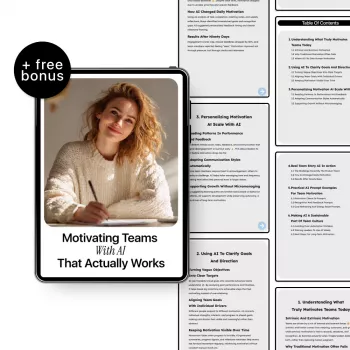
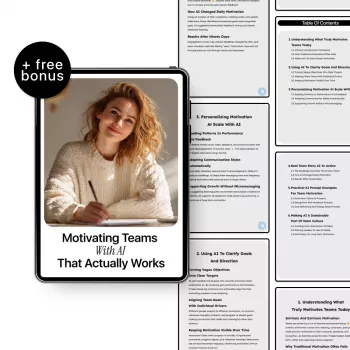
Motivating Teams With AI That Actually Works: a practical path to engagement
Team motivation tends to slip when priorities change faster than they’re communicated, feedback arrives inconsistently, and recognition doesn’t match what different people actually value. Used the right way, AI can help managers create clarity, spot friction earlier, and personalize support—without turning work into surveillance. The goal isn’t “more automation.” It’s better alignment, fewer surprises, and more time for coaching and removing blockers.
What “AI that actually works” looks like for team motivation
Effective AI support for motivation is lightweight, transparent, and conversation-first. It helps managers do the basics consistently—without creating a “productivity score” culture.
- Improves conversations and clarity, rather than monitoring keystrokes or activity levels.
- Uses small, existing inputs (goals, 1:1 notes, project updates, retros) to generate helpful summaries and next steps.
- Creates consistency across check-ins, recognition, and expectations so the team experiences fairer leadership.
- Stays transparent about what data is used, how outputs are used, and what is never tracked.
- Boosts manager leverage by reducing admin work so leaders can coach, unblock, and develop people.
Common motivation problems AI can solve (without adding more meetings)
The most practical use cases focus on turning messy signals into simple decisions.
- Goal drift: converts big objectives into weekly priorities with measurable outcomes.
- Misalignment: flags conflicting commitments across projects or stakeholders early.
- Invisible work: surfaces contributions that don’t show up in dashboards (mentoring, support, incident response).
- Recognition mismatch: adapts appreciation to what people value (growth, autonomy, impact, stability).
- Manager overload: summarizes updates, tracks commitments, and suggests coaching prompts for 1:1s.
- Burnout risk: highlights sustained overload patterns and recurring blockers—then prompts a workload conversation.
For evidence-backed goal-setting and engagement context, see Google re:Work on OKRs and Gallup engagement research.
A simple framework: Align → Support → Recognize → Improve
A motivation system works best when it’s repeatable. This four-step loop keeps focus on outcomes and people at the same time.
Align
Translate strategy into team outcomes, then into personal weekly commitments. Clarity reduces anxiety—and prevents “busy work” from becoming the default.
Support
Identify blockers and motivation drivers, then plan small interventions: clearer scope, better resources, skill-building, autonomy, or tighter decision-making.
Recognize
Deliver timely, specific recognition tied to outcomes and behaviors, tailored to the individual. Recognition is more motivating when it connects effort to impact.
Improve
Run short feedback loops (weekly pulse + retro themes), then adjust goals, workload, and communication. The point is steady course correction, not perfection.
Practical AI-assisted routines by cadence
| Cadence | Team routine | What AI produces | Manager action |
|---|---|---|---|
| Daily (5–10 min) | Async updates | Summary of progress, risks, dependencies | Remove blockers, adjust priorities |
| Weekly (30 min) | Priority sync | Proposed weekly goals, trade-off options | Confirm commitments and “not doing” list |
| Biweekly | 1:1 coaching | Coaching questions and recap template | Ask, listen, document agreements |
| Monthly | Recognition review | Draft recognition notes linked to outcomes | Send specific appreciation; amplify in team channels |
| Quarterly | Goal refresh | Outcome mapping and alignment gaps | Reset objectives, re-balance workload |
Personalized motivation without becoming intrusive
Personalization helps when it’s consent-based and used for support—not labeling.
- Use preference-based inputs: ask what motivates each person (learning, ownership, visibility, stability, mission, flexibility).
- Separate performance from support: personalization should inform coaching and recognition, not become a scoring system.
- Treat outputs as suggestions: managers decide; team members can correct assumptions.
- Offer opt-outs for sensitive data: avoid personal content, private messages, or anything unrelated to work commitments.
- Default to aggregation: track team-level morale and workload signals rather than individual surveillance.
If you want a trustworthy guardrail mindset for workplace AI, the NIST AI Risk Management Framework is a solid reference for transparency and risk controls.
Ready-to-use workflows: prompts, checklists, and templates that save time
Motivation improves when managers do small things consistently. These workflows keep the lift low while increasing follow-through.
- Weekly alignment checklist: objectives → outcomes → tasks → owners → due dates → dependencies → risks → “not doing.”
- 1:1 helper workflow: summarize last agreements, propose three coaching questions, draft a development micro-plan.
- Recognition workflow: translate outcomes into appreciation tied to impact and behaviors.
- Retro synthesis workflow: cluster themes, propose experiments, assign owners, define success measures.
- Onboarding alignment workflow: role clarity, 30/60/90-day outcomes, and early wins tied to team goals.
Motivating Teams With AI That Actually Works: what’s included and who it’s for
For leaders who want a practical, repeatable system, Motivating Teams With AI That Actually Works – Digital Guide, eBook & Checklist is built to turn these concepts into routines you can run weekly and monthly.
If you’re also shopping for practical, everyday items while you’re here, these in-stock picks are available: Genuine Leather Lambskin Crossbody Handbag – Stylish, Soft & Versatile and Men’s Genuine Leather Belt – Vintage Western Style with Pin Buckle, 1 Inch Wide.
Implementation tips: make it stick in 14 days
FAQ
Will AI-driven motivation feel fake or impersonal?
Not if AI is used to draft structure and reminders while the manager supplies the human context: specifics, sincerity, and timing. The most motivating messages reference real outcomes and reflect what the individual values.
How can AI help with goal alignment without adding bureaucracy?
AI can summarize updates, map objectives to weekly commitments, and flag conflicts so the team spends less time in status meetings. A short weekly priority sync plus a clear “not doing” list keeps alignment tight without extra layers.
What data should be avoided to keep team trust?
Avoid private messages, personal content, and surveillance-style metrics. Use only the minimum work-related inputs needed, keep it transparent, offer opt-outs where appropriate, and focus on aggregated signals over individual monitoring.










Leave a comment